Solución analítica del problema de conducción de calor en un paralelepípedo tridimensional con condiciones no homogéneas en la frontera
DOI:
https://doi.org/10.66482/yvqcd170Palabras clave:
modelación matemática, ecuación del calor, condiciones de frontera no homogéneas, separación de variables, paralelepípedoResumen
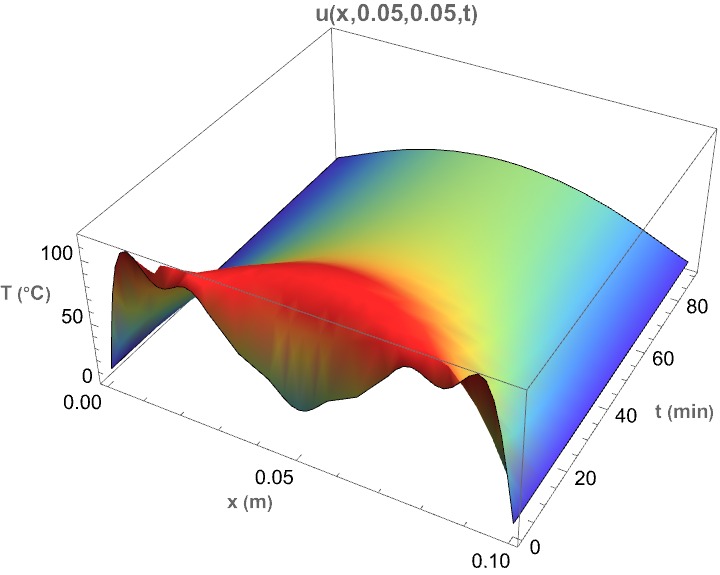
La ecuación del calor se ha consolidado como uno de los modelos matemáticos fundamentales de la física matemática para estudiar los fenómenos de transferencia de energía térmica. En este trabajo se presenta una solución analítica para la ecuación del calor tridimensional en un paralelepípedo sometido a diferentes temperaturas impuestas en cada una de sus seis caras. El análisis se basa en el método de separación de variables y el desarrollo en series de funciones ortogonales. Se analiza un caso representativo de hueco térmico cuya evolución está determinada por condiciones de frontera no homogéneas en un dominio tridimensional. Como consecuencia, se observa la necesidad de resolver la ecuación de Laplace con el fin de obtener la distribución de frontera tridimensional. Al analizar la evolución temporal, se observa un comportamiento consistente con las predicciones del modelo de la ecuación del calor y en concordancia con las leyes vigentes de la termodinámica.
Descargas
Referencias
S. Zhang, “Recent progresses on real-time 3D shape measurement using digital fringe projection techniques,” Optics and Lasers in Engineering, vol. 48, no. 2, pp. 149–158, 2010. https://doi.org/10.1016/j.optlaseng.2009.03.008
C. Quan, W. Chen, and C. J. Tay, “Phase-retrieval techniques in fringe-projection profilometry,” Optics and Lasers in Engineering, vol. 48, no. 2, pp. 235–243, 2010. https://doi.org/10.1016/j.optlaseng.2009.06.013
C. Zuo, L. Huang, M. Zhang, Q. Chen, and A. Asundi, “Temporal phase unwrapping algorithms for fringe projection profilometry: A comparative review,” Optics and Lasers in Engineering, vol. 85, pp. 84–103, 2016. https://doi.org/10.1016/j.optlaseng.2016.04.022
C. Zuo, S. Feng, L. Huang, T. Tao, W. Yin, and Q. Chen, “Phase shifting algorithms for fringe projection profilometry: A review,” Optics and Lasers in Engineering, vol. 109, pp. 23–59, 2018. https://doi.org/10.1016/j.optlaseng.2018.04.019
S. Zhang and P. S. Huang, “Phase error compensation for a 3-D shape measurement system based on the phase-shifting method,” Optical Engineering, vol. 46, no. 6, p. 063601, 2007. https://doi.org/10.1117/1.2746814
Z. Li, Y. Shi, C. Wang, and Y. Wang, “Accurate calibration method for a structured light system,” Optical Engineering, vol. 47, no. 5, p. 053604, 2008. https://doi.org/10.1117/1.2931517
S. Lei and S. Zhang, “Flexible 3-D shape measurement using projector defocusing,” Optics Letters, vol. 34, no. 20, pp. 3080–3082, 2009. https://doi.org/10.1364/OL.34.003080
G. A. Ayubi, J. A. Ayubi, J. M. Di Martino, and J. A. Ferrari, “Pulse-width modulation in defocused three-dimensional fringe projection,” Optics Letters, vol. 35, no. 21, pp. 3682–3684, 2010. https://doi.org/10.1364/OL.35.003682
J. Dai, B. Li, and S. Zhang, “High-quality fringe pattern generation using binary pattern optimization through symmetry and periodicity,” Optics and Lasers in Engineering, vol. 52, pp. 195–200, 2014. https://doi.org/10.1016/j.optlaseng.2013.06.010
J. Dai, B. Li, and S. Zhang, “Intensity-optimized dithering technique for three-dimensional shape measurement with projector defocusing,” Optics and Lasers in Engineering, vol. 53, pp. 79–85, 2014. https://doi.org/10.1016/j.optlaseng.2013.08.015
Y. Xiao and Y. Li, “High-quality binary fringe generation via joint optimization on intensity and phase,” Optics and Lasers in Engineering, vol. 97, pp. 19–26, 2017. https://doi.org/10.1016/j.optlaseng.2017.05.006
F. Lu, C. Wu, and J. Yang, “High-quality binary fringe patterns generation by combining optimization on global and local similarity,” Journal of the European Optical Society-Rapid Publications, vol. 14, no. 12, 2018. https://doi.org/10.1186/s41476-018-0081-0
A. Silva, A. Muñoz, J. L. Flores and J. Villa, “Exhaustive dithering algorithm for 3D shape reconstruction by fringe projection profilometry,” Applied Optics, vol. 59, no. 13, pp. 31–38, 2019. https://doi.org/10.1364/AO.381924
D. C. Ghiglia and L. A. Romero, “Robust two-dimensional weighted and unweighted phase unwrapping that uses fast transforms and iterative methods,” Journal of the Optical Society of America, vol. 11, no. 1, pp. 107–117, 1994. https://doi.org/10.1364/JOSAA.11.000107
P. Siarry, G. Berthiau, F. Durdin and J. Haussy, “Enhanced simulated annealing for globally minimizing functions of many continuous variables,” ACM Transactions on Mathematical Software, vol. 23, no. 2, pp. 209–228, 1997. https://doi.org/10.1145/264029.264043
B. Suman and P. Kumar, “A survey of simulated annealing as a tool for single and multiobjective optimization,” Journal of the Operational Research Society, vol. 57, no. 10, pp. 1143–1160, 2005. https://doi.org/10.1057/palgrave.jors.2602068
J. H. Holland, “Genetic Algorithms,” Scientific American, vol. 267, no. 1, pp. 66–72, 1992. https://doi.org/10.1038/scientificamerican0792-66
Antonio Muñoz, Omar Aguilar-Loreto and Abimael Jiménez-Pérez, “Patrones binarios unidimensionales para reconstrucción 3D: planteamiento inicial,” Innovación y Desarrollo Tecnológico Revista Digital, vol. 17, no. 2, pp. 1084–1091, 2025.
G. Garnica, M. Padilla and M. Servin, “Dual-sensitivity profilometry with defocused projection of binary fringes”, Applied Optics, vol. 56, no. 28, pp. 7985–7989, 2017. https://doi.org/10.1364/AO.56.007985
Descargas
Publicado
Número
Sección
Licencia
Derechos de autor 2025 Revista Ciencia Aplicada

Esta obra está bajo una licencia internacional Creative Commons Atribución-NoComercial-SinDerivadas 4.0.